

Wild camping in Scotland
By Colin Hogarth
Here at walkscotland.com we frequently receive emails, particularly from overseas visitors, asking about wild camping in Scotland. Questions include its legality and whether a permit is necessary (such a thing doesn't exist). Through this article we hope to address the majority of points relating to pitching up in the great outdoors.
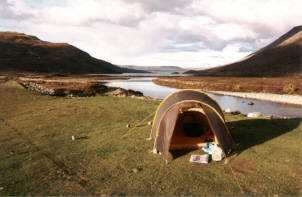
Wild camping is one of the great pleasures of exploring the Scottish countryside. There's few more enjoyable ways to spend an evening than sitting by a remote Highland lochan, a glass of whisky in hand, watching the sun set over the mountains. It's an experience everyone should enjoy, at least once in their lives. But how can you prevent such an idyllic moment being tarnished by a sudden visit from an angry estate factor demanding you clear off his master's land? In reality this doesn't happen too often in Scotland and if you camp responsibly it really shouldn't ever happen to you.
Legally speaking the Trespass (Scotland) Act of 1865 makes it an offence to camp or light fires on private land without the consent of the landowner. This has not been used recently against hillwalkers and wild camping is tolerated. The Mountaineering Council of Scotland has long campaigned to have this legislation amended so responsible wild camping is no longer technically a criminal offence.
Another law on the statute book is the Criminal Justice and Public Order Act (1994). This gives police powers to deal with either an encampment which involves more than six vehicles or a smaller encampment where there is damage or a public order offence. This was introduced to deal with so called 'new age travellers'. It has not yet affected wild camping and is unlikely to do so.
Finally, the Road Traffic Act 1988 makes it an offence to drive a motor vehicle onto private land without lawful authority. No offence is committed, however, where a person drives within 15 yards of a public road for the purpose of parking. However, this does not imply that a person has a right to do so. This has no impact on wild camping, unless of course you tear over someone's estate to your remote campsite in a Land Rover Discovery!
There are a few simple pieces of advice to bear in mind when wild camping. The bottom line is to be considerate and remember people have to make a living from the land.
Try and be as inconspicuous as possible. Pitch up well away from houses and farms. Don't camp on agricultural fields. If there is no option but to camp near a house or farm, do ask permission first. If the answer is a firm no, press on. Often, however, the person you ask may suggest a suitable place. Sometimes walkers have even found themselves being invited in for a cup of tea and a round of scones. You never know your luck. If there are 'No Camping' signs, respect them.
Also bear in mind the impact your camping will have on the flora and fauna. Leaving your tent on one spot for too long damages ground vegetation. Plants are more sensitive at higher altitudes so aim to camp lower down in glens where vegetation recovers more easily.
Don't cut live wood and remember that dead wood is an important habitat for insects and many small animals, so avoid fires even for cooking, unless of course you are on the coast and there is a ready supply of driftwood. Open fires pose a high fire risk on peaty soils and close to tinder dry grass, or woodland. They will also draw attention to your campsite.
If you feel you must have a fire, and it is safe to do so, dig up a square of turf and put it to one side so it can be placed back over the site of your fire to ensure no trace is left behind. Line your fireplace with large stones to prevent it spreading. Remember too that coniferous wood can spit sparks, damaging expensive fleece jackets, or tents pitched too close. Watercourses and loch sides are important sites for birds and animals. Avoid the temptation to camp immediately beside them. Look around for other sites if possible.
Don't scatter food scraps - they attract scavenging birds and animals which prey on more sensitive nesting birds. Be prepared to move if you become aware that you are disturbing nesting birds or animals. Keep your food store tidy and protected. While bears won't come in the night and steal your stores, I have known particularly voracious seagulls to swoop down and pull things out from under a tent flysheet.
Bag up all your rubbish and carry it out with you. Don't bury it or hide it under rocks. Scour your campsite before you leave to ensure you haven't left anything at all behind. The only trace of your having been there should be some flattened grass.
People go to the hills for solitude so keep groups small and pitch away from other campers - they don't necessarily want to hear your snoring, or whatever other sounds may emanate from your sleeping bag during the night! Noise travels from tents disturbing both wildlife and humans.
While commercial campsites offer a range of facilities, including toilets and showers, wild campers have to live without such home comforts. If you're out for several days, the laws of nature mean the time will come when you need to have a crap. Always find a spot at least 30 metres from fresh running water before you drop your pants, and make sure you're well away from structures like bothies.
Backpackers should always carry a little trowel with them (or in the winter you can alternatively use an ice axe). Dig a small hole, crap into it, and then fill it in once you're finished. Don't simply bury your waste under boulders. For the ladies, buried tampons and sanitary towels can be dug up by animals so bag them up and carry them out.
Pitching up at the side of a public road is not considered wild camping, however remote the route. Better to use an official campsite with sanitation facilities if there is one available in the area. If you have to camp by the road, avoid overused sites, take particular care with toilet hygiene, pitch late and leave early.

The Mountaineering Council of Scotland publishes a leaflet entitled 'Wild Camping - A Guide to Good Practice'. Copies are available from their office in Perth. See our links page for contact details.